
Introduction
In Barry Jenkins’ Moonlight, there is a scene where young Chiron, bullied and fleeing from classmates, finds refuge in an abandoned apartment. Juan, a local drug dealer, discovers him hiding inside, knees pulled to chest, silent and trembling. Juan doesn’t demand explanation or performance. He simply sits with the boy, offers food, asks gentle questions. Later, teaching Chiron to swim in the ocean, Juan holds him afloat and tells him: “At some point, you got to decide for yourself who you’re gonna be. Can’t let nobody make that decision for you.”
The tragedy of Moonlight is that Chiron never gets to make that decision freely. The world around him has already decided what he must become to survive. As a Black boy growing up in Liberty City, Miami, surrounded by poverty and violence, Chiron learns early that softness is vulnerability and vulnerability is danger. His queerness, his sensitivity, his desire for connection become liabilities in an environment where masculinity functions not as identity but as armor. The film traces Chiron’s life across three chapters (Little, Chiron, Black), documenting how he learns to perform hardness, how that performance gradually calcifies into personality, and how the protective shell that keeps him safe from the world simultaneously locks him out from the intimacy he desperately craves.
Moonlight demonstrates that masculinity can function as a survival strategy in Black contexts, training boys to perform hardness to earn safety, until that performance collides with sexuality and attachment, turning intimacy into a threat instead of a refuge. The film reveals how intersecting oppressions (racism, homophobia, poverty) create environments where vulnerable populations must adopt protective performances that ultimately foreclose the very connections that make survival psychologically meaningful. Chiron doesn’t choose hardness because it reflects his authentic self. He chooses it because the alternative is annihilation, and by the time he realizes the cost, the performance has become indistinguishable from the person.
This essay explores how Moonlight dramatizes the psychological mechanisms through which threatened communities teach protective performance, how those performances become internalized as identity, and how the armor constructed for survival becomes a prison preventing the intimacy required for genuine flourishing. Drawing on theories of identity development, research on minority stress and intersectionality, and psychological work on attachment and masculinity, the essay argues that Chiron’s transformation from soft to hard is not personal failure but predictable adaptation to an environment that punishes authenticity and rewards performative invulnerability.
Masculinity as Survival Technology in Threatened Communities
To understand what happens to Chiron, we must first understand the environment that shapes him. Liberty City is not merely economically disadvantaged. It is a space where structural violence (police presence, drug economies, absent opportunities) creates constant ambient threat (Sharkey, 2018). In such environments, vulnerability becomes dangerous. Children learn early that showing weakness invites predation, that emotional expressiveness marks you as a target, that survival requires cultivating an exterior that deflects attention and preempts attack.
This is the context in which Black masculinity often develops, not as toxic culture imported from nowhere but as rational adaptation to environments structured by racism and economic abandonment. Sociologist Elijah Anderson’s ethnographic work in similar communities documents how young Black men adopt a “code of the street” emphasizing toughness, respect, and willingness to use violence, precisely because institutional protection (from police, schools, or economic opportunity) is unavailable (Anderson, 1999). When formal systems fail to provide safety, informal codes emerge to fill the gap. Masculinity becomes a technology of survival, a set of performative strategies designed to navigate threat.
The film illustrates this through Chiron’s encounters with Terrel, the primary antagonist who relentlessly bullies him. Terrel doesn’t target Chiron arbitrarily. He targets him because Chiron is soft, because he moves differently, speaks differently, exists differently than the prescribed masculine norm. In the hallway, in the cafetblock, on the field, Terrel tests Chiron’s hardness, probing for weakness. Each test is a lesson: this is what happens to boys who don’t perform masculinity correctly. The violence isn’t random. It’s pedagogical, teaching Chiron and every witness that deviation from masculine norms carries consequences.
Psychological research on minority stress helps explain this dynamic. Meyer’s minority stress model demonstrates that individuals with stigmatized identities face chronic stress from discrimination, expectations of rejection, and the need to conceal stigmatized aspects of self (Meyer, 2003). For Chiron, the stress is multiplicative: he faces racism as a Black child in a surveillance-heavy, under-resourced community, and he faces homophobia in a context where queerness is read as weakness and weakness as justification for violence. The intersection of these stigmatized identities creates what Crenshaw terms intersectionality, where overlapping systems of oppression produce unique vulnerabilities not reducible to any single category (Crenshaw, 1991).
In this context, performing hegemonic masculinity becomes protective. If Chiron can successfully embody hardness, he might deflect the violence directed at boys perceived as weak or queer. This isn’t internalized homophobia in the conventional sense, though that’s part of it. It’s strategic self-preservation. The performance serves a function: it creates a facade that might keep him safe in an environment where his authentic self marks him for harm.
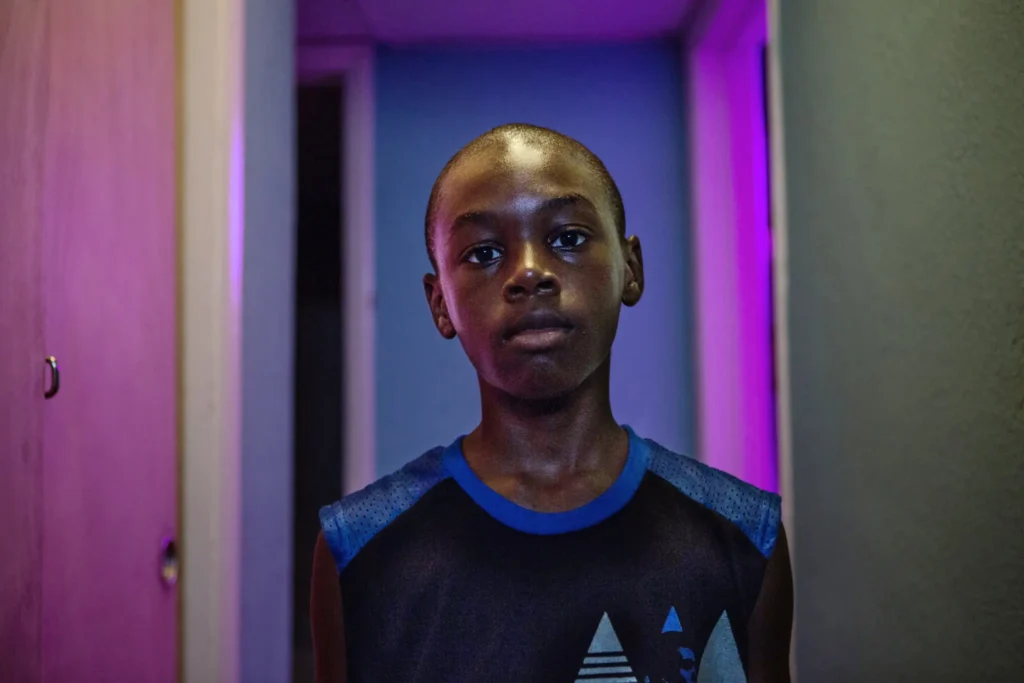
The film’s visual language reinforces this. Young Chiron is often filmed in blues and purples, soft lighting that emphasizes his gentleness and vulnerability. The camera lingers on his face, capturing his expressiveness and emotional availability. By the final chapter, after his transformation into “Black,” the visual palette shifts. He’s lit more harshly, filmed in ways that emphasize his physicality and hardness, the camera maintaining more distance. The cinematography itself reflects how Chiron has learned to present himself, how vulnerability has been replaced by impermeability.
Juan serves as Chiron’s primary model for an alternative Black masculinity, one that combines strength with tenderness. Juan is embedded in street economies (he sells drugs), but he mentors Chiron with genuine care, teaching him to swim, offering refuge, modeling that men can be both tough and gentle. Yet even Juan’s example is constrained. He can show Chiron occasional softness in private moments, but he cannot protect Chiron from the broader environment that punishes any sustained deviation from hardness. Juan’s own life reflects these constraints: his tenderness toward Chiron coexists with his participation in systems (drug dealing) that perpetuate the very violence and instability that endanger children like Chiron.
This speaks to how masculinity functions as collective survival strategy in marginalized communities. Individual men might recognize the costs of rigid masculine performance, might wish for greater emotional freedom, but they cannot individually opt out without consequences. The performance is maintained not primarily through individual choice but through social enforcement. Boys police each other’s masculinity because they’ve learned that collective adherence to the code provides group protection, even as it constrains individual flourishing (Pascoe, 2007). Chiron cannot simply refuse to perform hardness because refusal would isolate him from the peer networks that provide safety and belonging.
The Pedagogy of Hardness: Learning to Suppress Vulnerability
Moonlight functions as a developmental chronicle, showing how Chiron learns across childhood and adolescence to suppress the parts of himself that invite harm. This learning process is not abstract. It occurs through concrete, often violent lessons that teach him which aspects of his personality are acceptable and which must be hidden or eliminated.
In the first chapter, “Little,” Chiron is legible as a child: curious, frightened, emotionally expressive. When Juan asks if he’s okay, Chiron’s face reveals everything he feels. He hasn’t yet learned to construct the mask. But even at this young age, he’s receiving lessons. His mother Paula, struggling with addiction, oscillates between tenderness and cruelty, teaching him that love is unreliable and that emotional needs mark you as burdensome. His classmates teach him that his difference is punishable. The environment systematically communicates that his authentic self is unacceptable.
By the second chapter, “Chiron,” adolescence has intensified these lessons. Chiron has learned to go silent, to minimize his presence, to move through school hallways like he’s trying to disappear. His strategy is avoidance rather than confrontation, making himself as small and unobtrusive as possible. But this strategy fails because his queerness isn’t just about behavior that can be hidden. It’s about how he exists in his body, how he looks at Kevin, how his desire exceeds his ability to conceal it.
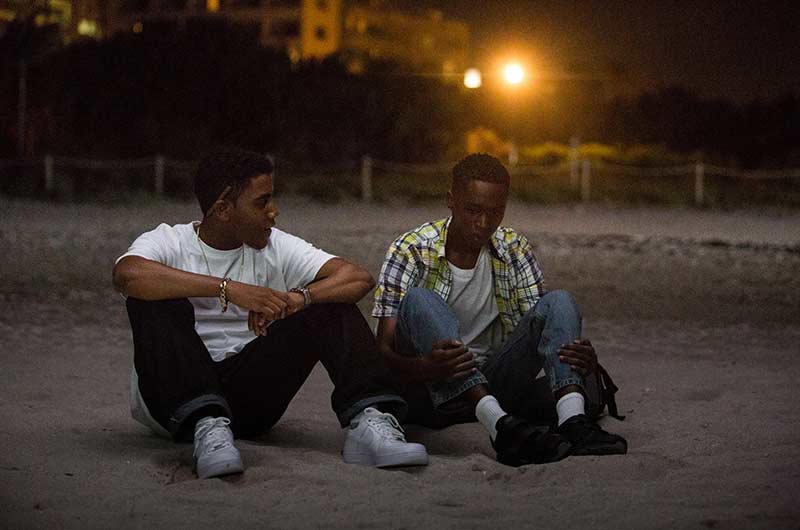
The beach scene with Kevin represents a moment of profound vulnerability where Chiron allows himself to want openly. Kevin touches him with a gentleness Chiron has rarely experienced, and Chiron permits himself to receive that touch, to lean into intimacy rather than armoring against it. The scene is suffused with tenderness and longing, with the possibility that connection might be available after all.
Then comes the betrayal. The next day, under peer pressure and the watchful eyes of Terrel, Kevin participates in Chiron’s public beating. The message is unmistakable: intimacy is dangerous, vulnerability will be weaponized, the people you trust will hurt you when maintaining social position requires it. This is the definitive lesson in why hardness is necessary. Chiron let his guard down, allowed himself to want and be wanted, and the consequence was humiliation and violence.
Attachment theory helps explain the psychological impact of this betrayal. Secure attachment develops when caregivers consistently respond to a child’s needs with sensitivity and reliability, teaching the child that the world is safe and that intimacy is refuge (Bowlby, 1988). Chiron’s attachment experiences teach the opposite. His mother is unreliable, oscillating unpredictably between warmth and cruelty. Juan provides temporary safety but cannot be a consistent presence. Kevin offers intimacy then participates in Chiron’s violation. Each experience reinforces an attachment pattern termed fearful-avoidant: the simultaneous desperate need for connection and terror that connection will lead to harm (Bartholomew & Horowitz, 1991).
The beating scene is particularly devastating because it occurs in front of an audience, transforming private vulnerability into public spectacle. Chiron is forced to endure repeated blows while classmates watch, his powerlessness on display. The humiliation is designed to be pedagogical, teaching everyone present what happens to boys who are soft, who are suspected of queerness, who fail to perform adequate masculinity. Chiron learns the lesson his environment has been teaching all along: vulnerability invites violence, intimacy is a trap, and survival requires building walls high enough that no one can reach you.
His response is telling. Rather than retreating further into avoidance, Chiron retaliates. He smashes a chair across Terrel’s back, unleashing violence with an intensity that shocks everyone, including himself. The retaliation is significant not just as revenge but as performance. Chiron is demonstrating that he can be hard, can be violent, can embody the masculinity the environment demands. He’s arrested and sent to juvenile detention, but in a perverse way, he’s also succeeded. He’s proven he’s not soft, not weak, not the easy target he once was.
Psychologically, this represents what trauma researchers call identification with the aggressor, where victims of violence adopt the characteristics and behaviors of those who harmed them as a defensive strategy (Ferenczi, 1949). By becoming hard like those who hurt him, Chiron protects himself from future victimization. But the protection comes at enormous cost. He doesn’t just perform hardness strategically; he internalizes it, allowing it to reshape his personality, his relationships, his sense of who he can be in the world.
When Performance Becomes Prison: The Calcification of Defensive Identity
The third chapter, “Black,” reveals the result of this transformation. Chiron has become exactly what his environment demanded: muscular, hardened, draped in gold teeth and chains, dealing drugs in Atlanta, embodying a hypermasculine persona nearly indistinguishable from the men who once threatened him. The soft boy from the first chapter seems to have disappeared entirely, replaced by a figure constructed for survival in hostile territory.
The visual transformation is striking. Chiron’s body has changed dramatically, bulked with muscle that functions as literal armor. His affect is flat, carefully controlled. He moves with deliberate slowness, occupying space in ways designed to project strength and deter challenge. Everything about his presentation communicates invulnerability. This is what successful defensive masculinity looks like: a self constructed to deflect threat, to command respect through intimidation, to never again be the vulnerable child crying in an abandoned apartment.
But the film refuses to let us read this transformation as empowerment. Jenkins’ camera work and Ashton Sanders’ performance reveal the cost. In quiet moments, when Black thinks no one is watching, the mask slips. His eyes reveal an exhaustion, a loneliness, a yearning for something the hardness cannot provide. He has gained safety but lost access to intimacy. He has protected himself from violence but locked himself out from connection. The armor that shields him from the world simultaneously imprisons him within it.
Psychological research on identity foreclosure illuminates what has happened to Chiron. Marcia’s identity development theory describes foreclosure as committing to an identity without adequate exploration of alternatives, often in response to external pressure (Marcia, 1966). Chiron hasn’t freely chosen who to become. He’s adopted an identity prescribed by his environment’s demands, foreclosing on other possibilities before he could genuinely explore what authentic selfhood might look like. The persona of “Black” is protective but inauthentic, a role he performs so consistently that the boundary between performance and person has dissolved.
This speaks to broader patterns in how marginalized individuals navigate hostile environments. Goffman’s work on stigma management describes how people with devalued identities engage in “covering,” minimizing the visibility of stigmatized characteristics to reduce discrimination (Goffman, 1963). Chiron covers his queerness, his sensitivity, his emotional needs beneath layers of masculine performance. But extensive research demonstrates that chronic covering carries severe psychological costs: depression, anxiety, diminished self-esteem, and profound loneliness resulting from the disconnection between public persona and private self (Pachankis, 2007).
The loneliness is what the film emphasizes most powerfully. Black has achieved a kind of success within street economies. He has money, status, the respect that comes from being dangerous. But he’s profoundly isolated. His romantic life is nonexistent. His friendships are instrumental rather than intimate. He cannot let anyone close because closeness requires vulnerability and vulnerability is what he’s spent years eliminating.
Then Kevin calls. The conversation is awkward, hesitant, heavy with everything unsaid. Kevin has been in prison, has a child, works at a diner. He’s followed a different path but carries his own regrets. When he invites Chiron to visit, the invitation represents a possibility Chiron thought he’d permanently foreclosed: the chance to reconnect with the person who saw him before he became “Black,” the person who knew his tenderness before it was weaponized against him.
Chiron’s decision to drive to Miami is momentous precisely because it means lowering his guard. He’s maintained safety through distance and hardness, and returning to Kevin means risking the vulnerability he’s spent a decade avoiding. The entire final sequence is suffused with this tension: Chiron’s desire for connection warring with his terror that intimacy will again lead to harm.
The Collision of Armor and Intimacy: When Protection Prevents Connection
The reunion between Chiron and Kevin occurs in Kevin’s diner, a modest space where Kevin cooks and serves food with care and attention. The setting is significant. Kevin has built a life around nourishment and hospitality, professions emphasizing care and service. He’s found a way to be masculine that incorporates tenderness, that allows him to provide for others without requiring hardness. His life isn’t perfect (he has regrets, speaks of paths not taken), but he’s achieved something Chiron hasn’t: a way of being in the world that doesn’t require constant performance of invulnerability.
Chiron watches Kevin cook, and the camera lingers on his face, capturing something we haven’t seen since he was a child: open longing. In Kevin’s presence, away from the environment that demands hardness, the armor begins to crack. When Kevin asks about his life, Chiron struggles to answer. What can he say? That he’s replicated the very systems that harmed him? That he’s successful by street metrics but profoundly alone? That he’s safe but not alive?
The conversation circles around what cannot quite be said directly. Kevin apologizes for the beach, for the beating, acknowledging the harm without fully articulating what it meant. Chiron accepts the apology without explaining what those events cost him. They’re two men who hurt each other and were hurt by systems larger than either of them, trying to find language for connection across years of protective silence.
Then Chiron breaks. “You’re the only man that’s ever touched me,” he admits, voice fracturing. “I haven’t really touched anyone since.” The confession is devastating in its simplicity. Chiron hasn’t just avoided romantic intimacy for a decade. He’s avoided touch itself, the basic human need for physical connection. The armor constructed to protect him has been so totalizing that it’s prevented not just sexual intimacy but any form of vulnerable human contact.
This moment reveals the fundamental tragedy of defensive masculinity: that the strategies developed to survive threat become obstacles to the very connections that make life meaningful. Chiron learned to be hard because softness was dangerous, and that hardness kept him physically safe but psychologically isolated. He built walls so high that no one could hurt him, but those same walls mean no one can reach him, including people who want to offer care rather than harm.
Psychological research on emotion regulation demonstrates this dynamic. Suppressive emotion regulation strategies (avoiding emotional expression, minimizing feelings, maintaining rigid control) can be adaptive in threatening contexts, reducing immediate distress and protecting against vulnerability (Gross & John, 2003). But chronic suppression carries severe long-term costs: diminished positive emotion, impaired social relationships, increased depression and anxiety, and profound loneliness. Chiron has become expert at suppression, but expertise in not feeling has left him unable to access the emotional availability that intimacy requires.
The film’s final image is Kevin holding Chiron from behind, recreating the position from their beach encounter years earlier. Chiron permits himself to be held, to lean back into Kevin’s embrace, to accept comfort without armoring against it. For a moment, the hardness dissolves. The camera returns to young Chiron on the beach bathed in blue moonlight, suggesting that the soft child never disappeared, just learned to hide so thoroughly that even Chiron lost access to him.
This ending resists easy resolution. Jenkins doesn’t suggest that one moment of vulnerability undoes years of defensive adaptation or that intimacy with Kevin will magically heal what institutional violence fractured. The ending is quieter and more ambiguous. It suggests possibility: that Chiron might begin to dismantle the armor, that intimacy might be available if he can tolerate the vulnerability it requires, that the hard shell constructed for survival might not have to be permanent.
The Social Production of Defensive Masculinity
While Chiron’s story is deeply personal, Moonlight insists we understand his transformation as socially produced rather than individually chosen. The film continually contextualizes his development within the structural conditions that make hardness rational and softness dangerous. This framing resists pathologizing Chiron or reading his masculinity as cultural deficiency, instead revealing it as adaptation to environments shaped by racism, poverty, and homophobia.
Research on Black masculinity frequently emphasizes this point. Scholars like bell hooks argue that constructions of Black masculinity as inherently toxic ignore how racist violence and economic exclusion create contexts where hypermasculine performance serves protective functions (hooks, 2004). When employment is unavailable, when police presence is predatory rather than protective, when schools fail to provide safe environments, young Black men develop alternative strategies for achieving respect, safety, and survival. These strategies often emphasize physical toughness, willingness to defend oneself, and public performance of strength precisely because institutional routes to safety and respect are foreclosed.
Moonlight doesn’t romanticize these adaptations. It shows their costs clearly. Paula’s addiction, Juan’s involvement in drug economies, the violence that permeates Liberty City, none of this is celebrated. But the film insists we understand these patterns as responses to structural abandonment rather than cultural pathology. Chiron doesn’t become hard because Black culture values hardness abstractly. He becomes hard because his specific environment punishes softness and rewards masculine performance, and that environment is structured by deliberate policy choices about where to invest resources, how to police communities, which populations to abandon.
The film also reveals how homophobia functions within these contexts. Queerness is policed so violently in Liberty City not because the community is uniquely homophobic but because, in contexts of intense vulnerability, any deviation from narrow norms feels threatening to collective survival strategies. When masculinity serves protective functions for the group, individual deviations (queerness, sensitivity, gentleness) can be read as undermining collective security. This doesn’t justify the violence Chiron experiences, but it contextualizes it within systems of overlapping oppressions.
Intersectionality theory proves crucial here. Chiron’s experience cannot be understood through single-axis analysis. He’s not just experiencing racism, or just homophobia, or just class oppression. He’s navigating the unique vulnerabilities produced where these systems intersect (Crenshaw, 1991). As a poor Black queer boy, he faces threats that are both multiplicative and qualitatively distinct from what he’d experience with any single stigmatized identity. The masculinity he must perform is shaped by all these forces simultaneously: racism that denies Black men access to institutional respect, homophobia that punishes queer desire, and economic abandonment that makes alternative routes to safety unavailable.
The film also suggests how these patterns reproduce across generations. Chiron becomes a drug dealer like Juan, replicating the very systems that harmed him. But this replication isn’t mysterious. It’s structurally predictable. When legitimate economic opportunities are absent, when educational systems fail, when the primary models of Black male success within your community involve street economies, following that path becomes rational adaptation rather than moral failure. Chiron isn’t choosing to perpetuate harm. He’s navigating the constrained options his environment provides, just as Juan did, just as the next generation will unless structural conditions change.
The Possibility of Alternative Masculinities
Yet Moonlight isn’t purely deterministic. It suggests that alternative models of Black masculinity exist, even within constrained environments, and that connection might provide pathways out of defensive isolation. Juan, despite his contradictions, offers Chiron glimpses of masculinity that combines strength with care. Kevin, by the final chapter, has found ways to be nurturing and generative without requiring constant performance of hardness. These models don’t erase structural constraints, but they demonstrate that multiple ways of being a Black man exist, even in contexts that aggressively police masculine norms.
The film’s title references the moonlight’s effect on Black skin, making it appear blue. Juan tells young Chiron: “In moonlight, Black boys look blue.” The statement is about visibility and beauty, about how different light reveals different truths about who people are. It suggests that Chiron’s softness, his tenderness, his queerness aren’t deficiencies but aspects of himself that deserve to be seen and valued. The hard persona he constructs obscures these qualities but doesn’t eliminate them. They remain, waiting for conditions safe enough to emerge.
Research on resilience in LGBTQ communities demonstrates that connection serves protective functions against minority stress. When queer individuals find communities that affirm their identities, when they access models of people living authentically despite hostile contexts, when they build relationships not requiring constant self-monitoring and concealment, psychological outcomes improve significantly (Ryan et al., 2010). Chiron’s isolation magnifies his suffering. The brief moments of connection (with Juan, with Kevin) provide glimpses of what sustained community might offer: permission to be seen fully without requiring defensive performance.
The film also suggests that healing requires not just individual change but environmental transformation. Chiron cannot simply decide to be soft again while remaining in contexts that punish softness. Meaningful change requires either leaving those environments or changing the conditions that make hardness necessary. His journey to Atlanta represents a kind of geographic escape, though he carries Liberty City’s lessons with him. His reunion with Kevin represents a different possibility: that returning to the site of trauma with someone who shares that history might allow for renegotiating what’s possible there.
Conclusion: The Price of Survival and the Possibility of Living
Moonlight reveals that survival and living are not synonymous. Chiron survives his environment by learning to perform the masculinity it demands, by building armor thick enough to deflect the violence targeting vulnerable Black queer boys in communities structured by abandonment and oppression. The armor works. By the film’s final chapter, he’s physically safe, economically stable, respected within his context. He has survived.
But he hasn’t lived. The hardness that protects him also imprisons him, preventing the intimacy and vulnerability that make human existence meaningful. He’s safe from violence but not safe for connection. He’s defended against harm but also defended against love, touch, tenderness, the fundamental human needs that armor cannot fulfill. The performance of masculinity that began as survival strategy has calcified into identity, and by the time he recognizes the cost, the person he was has become nearly inaccessible beneath the person he’s had to become.
The film’s genius lies in refusing to frame this as personal failure. Chiron doesn’t fail to resist hardness due to weakness or internalized homophobia, though both play roles. He adopts hardness because his environment made softness untenable, because every attempt at vulnerability was met with violence or betrayal, because the structural conditions of his life taught him that armor was necessary for survival. His transformation is tragic not because he made wrong choices but because the environment offered him no good choices, only strategies for surviving conditions that shouldn’t exist.
This matters beyond Chiron’s individual story because it reveals how systems of oppression operate through the very selves they target. Racism, homophobia, and economic abandonment don’t just create external barriers. They shape how people understand themselves, what they believe they’re allowed to want, which parts of themselves they learn to suppress or eliminate. The violence becomes internalized, turning people into enforcers of their own constraint. Chiron doesn’t need external forces to police his queerness or sensitivity by the final chapter. He’s internalized those forces so thoroughly that he polices himself, maintains his own armor, refuses his own vulnerability.
Yet the film’s ending suggests that internalization isn’t irreversible. The soft child still exists beneath the hardened exterior, not erased but protected, waiting for conditions safe enough to emerge. When Kevin holds him and Chiron permits himself to be held, the armor cracks. It doesn’t shatter completely or permanently, but it cracks, revealing that the person beneath hasn’t been destroyed, just hidden. The possibility exists that Chiron might learn to selectively lower his guard, might find people and spaces safe enough to risk vulnerability, might discover that intimacy doesn’t always lead to violation.
This is the film’s cautious hope: not that individual resilience can overcome structural violence, not that love conquers all, not that Chiron can simply choose to be soft in a world that punishes softness. Rather, that recognizing how environment shapes self might enable some conscious renegotiation of what’s necessary and what’s chosen, that connection with people who share your history might provide enough safety to begin dismantling defenses, that the armor built for survival might be revealed as exactly that (armor, not self) and therefore something that can be removed in contexts that don’t require constant defense.
Eleanor Roosevelt’s assertion that “no one can make you feel inferior without your consent” suggests we choose our self-perceptions freely. But Moonlight demonstrates that when environments systematically punish aspects of your authentic self, when vulnerability invites violence, when intimacy leads to betrayal, the “choice” to perform defensive identity isn’t really choice at all. It’s adaptation to conditions structured to make your authentic existence impossible. Chiron didn’t consent to becoming hard. He learned, through brutal lessons, that hardness was the price of survival. And by the time he realizes that survival without intimacy is a kind of death, the performance has become so deeply internalized that dismantling it requires excavating the child he once was from beneath the armor he’s had to become.
The film ends without resolving whether Chiron will successfully reclaim his softness, whether Kevin’s presence will be enough to make vulnerability feel safe, whether the structures that demanded hardness can be resisted or escaped. This ambiguity is honest. There are no easy answers for how people survive contexts that require them to betray their authentic selves, no simple paths for healing identities fractured by adaptation to violence. But in showing us Chiron’s face in that final embrace, allowing us to see the longing and fear and tentative hope there, Moonlight insists that the question remains open. The armor was built. Perhaps it can also be removed. The person underneath hasn’t died. Perhaps he can still learn to live.
References
- Anderson, E. (1999). Code of the street: Decency, violence, and the moral life of the inner city. New York: W.W. Norton.
- Bartholomew, K., & Horowitz, L. M. (1991). Attachment styles among young adults: A test of a four-category model. Journal of Personality and Social Psychology, 61(2), 226-244.
- Bowlby, J. (1988). A secure base: Parent-child attachment and healthy human development. New York: Basic Books.
- Crenshaw, K. (1991). Mapping the margins: Intersectionality, identity politics, and violence against women of color. Stanford Law Review, 43(6), 1241-1299.
- Ferenczi, S. (1949). Confusion of the tongues between the adults and the child: The language of tenderness and of passion. International Journal of Psychoanalysis, 30, 225-230.
- Goffman, E. (1963). Stigma: Notes on the management of spoiled identity. Englewood Cliffs: Prentice-Hall.
- Gross, J. J., & John, O. P. (2003). Individual differences in two emotion regulation processes: Implications for affect, relationships, and well-being. Journal of Personality and Social Psychology, 85(2), 348-362.
- hooks, b. (2004). We real cool: Black men and masculinity. New York: Routledge.
- Jenkins, B. (Director). (2016). Moonlight [Film]. A24.
- Marcia, J. E. (1966). Development and validation of ego-identity status. Journal of Personality and Social Psychology, 3(5), 551-558.
- Meyer, I. H. (2003). Prejudice, social stress, and mental health in lesbian, gay, and bisexual populations: Conceptual issues and research evidence. Psychological Bulletin, 129(5), 674-697.
- Pachankis, J. E. (2007). The psychological implications of concealing a stigma: A cognitive-affective-behavioral model. Psychological Bulletin, 133(2), 328-345.
- Pascoe, C. J. (2007). Dude, you’re a fag: Masculinity and sexuality in high school. Berkeley: University of California Press.
- Ryan, C., Russell, S. T., Huebner, D., Diaz, R., & Sanchez, J. (2010). Family acceptance in adolescence and the health of LGBT young adults. Journal of Child and Adolescent Psychiatric Nursing, 23(4), 205-213.
- Sharkey, P. (2018). Uneasy peace: The great crime decline, the renewal of city life, and the next war on violence. New York: W.W. Norton.